

This is an old revision of the document!
Setting Up an OPOS Printer For GT-POS
This document walks users through the process of setting up a USB-connected, OLE-Point of Sale (OPOS)-compliant POS printer for CDA GT-Point of Sale. Although it specifically refers to the Epson TM-82II POS printer, the procedure should be similar for other printers and from other manufacturers. Consult your printer documentation for specific details. Please note that you should contact your printer manufacturer or supplier for detailed assistance and/or troubleshooting if required in setting up your printer and/or cash drawer; CDA Software is not in a position to provide product-specific help.
The Epson TM-82II USB POS Printer is a low-cost, medium-duty receipt printer well suited for use with CDA GT Point of Sale. It supports the OPOS standards developed by Microsoft and printer manufacturers which implements a kind of “broker” software layer between applications programs and the physical hardware, designed to eliminate the need for significant changes when either the POS application or the receipt printer is changed. In order to do this, each printer manufacturer supporting the standard supplies special drivers that convert the standard OPOS commands supplied by the applications program into device-specific commands that cause the printer to act in the desired way, for example to print in a bold font, underlined or right-aligned.
CDA GT-POS supports the older ESC/P standards over serial or parallel printer connections, and the newer OPOS standards over all printers that also support the OPOS standards.
The OPOS “broker” level software supplied by the printer manufacturer may not be installed automatically when you install the printer drivers in the usual way. The following instructions assume the printer being installed is connected to the workstation via a USB cable; where differences are known they are noted, however you may need to experiment or seek further advice.
Install the printer software in the usual way. As always, you should be logged in to the machine as an Administrator to properly install software. For the Epson TM-82II, follow the Epson instructions to set up the printer and run the setup software on the supplied CD. At the Select Installation Type prompt select Custom Install:
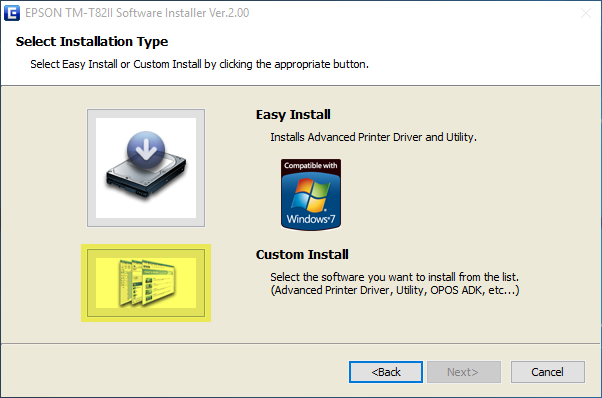
At the Select Software prompt ensure that OPOS ADK is selected in addition to the Advanced Printer Driver and TM-T82II Utility:
![[sc 2]](/docsonline/lib/exe/fetch.php?media=gt-pos:gtpos-epson2.png "[sc 2]")
Note that the version numbers may be diffeent to those shown here.
Proceed through the installation phase. The Printer Registration window will eventually be displayed:
[sc 3]
Click Next and the Register, Change and Delete Epson TM Printer window will be displayed:
[sc 4]
For a USB-connected printer, select USB from the Port Type drop-down box. Otherwise select the appropriate connection type. If desired, you can give the printer a different name and set it as the default printer, before clicking Save Settings. After a short delay the confirmation prompt will appear:
[sc 5]
Ensure that the printer is connected and powered on, then click Yes to perform a test print and verify all is correct. A Windows test print should be printed. If not you will need to troubleshoot before proceeding further. If all went as expected click Next to complete the driver installation process.
The OPOS ADK installation program will then begin. Proceed as usual until the Select Registry File prompt appears:
[sc 6]
If you have a pre-saved Registry file select the Use registry file option, otherwise select No registry file, and click Next. At the Setup Type prompt
[sc 7]
select User, then click Next and proceed until the Port selection prompt appears:
[sc 8]
For a USB-connected printer select USB Port, otherwise select the appropriate option for your printer. Then click Next and the installation will run to completion.
The OPOS ADK Setup Utility will then start automatically. This is where you will configure the new printer, and cash drawer if fitted, to be compatible with OPOS software applications.
[sc 9]
Select Add New Device from the Edit menu:
[sc 10]
Select POS Printer at the Add New Device (Select DeviceClass) prompt, and click Next.
[sc 11]
The Add New Device (Select DeviceNameKey) prompt is displayed. CDA applications by default use the Logical Device Name “POSP1” for a POS printer, so for ease of use enter that in the box in the Add New LDN panel, then click Next:
[sc 12]
The Add New Device (Communication Settings) prompt is displayed. For USB-connected printers you shouldn't need to make any changes here. Just click the Check Health Interactive button to test your setup.
[sc 13]
The POS Printer Check Health Interactive window will be displayed:
[sc 14]
Click Start to run the check and if all is OK the OPOS_SUCCESS message will be displayed in the Result box:
[sc 15]
Click Close and Finish to complete this step. You will be returned to the OPOS ADK Setup Utility window.
If you do not have a Cash Drawer attached to your POS Printer, you are done so you can close the OPOS ADK Setup Utility window. Otherwise, select the Edit | Add New Device menu again, and this time select Cash Drawer at the Add New Device (Select DeviceClass) prompt:
[sc 16]
Click Next. At the Add New Device (Select DeviceNameKey) prompt, select Standard from the Device Name drop-down box and Standard U from the Select detailed model drop-down. Enter the CDA default “POSP1Drawer” in the Logical Device Name box, then click Next:
[sc 17]
On the Select Connection Type window, your POS printer should already be selected. If not, select it from the drop-down box. Then click OK.
[sc 18]
At the Add New Device (Communication Settings) prompt, you should not need to change anything, so just click the Check Health Interactive button to test the drawer open function.
[sc 19]
Click Start on the Cash Drawer Check Health Interactive window to perform the test.
[sc 20]
If the drawer does not open you will need to troubleshoot. Otherwise click Close, OK and Finish at successive prompts. You may then see a window with the quaint title The contradictory warning of a setup of registry. Click Cancel to ignore the prompt.
[sc 21]
You have now completed the Epson setup. Close the OPOS ADK Setup Utility window.
The Installation Finished window will be displayed. If you wish, you can run the TM-82II Utility after clicking the Finish button. The utility can be run at any time from the Epson program group.
[sc 22]
The utility provides a number of tests and settings you can explore at your convenience.
[sc 23]
You now need to select your OPOS printer to be used within GT-Point of Sale. Select the Tools | Options menu and expand the Workstation and Printers sections.
[sc 24]
Tick the “Trigger cash drawer on Cash Sales invoices” option and select the “Use Docket Printer function” if your POS printer includes the interface to your cash drawer.
Then click the “Select & Configure” button to display the POS Printer Configuration window. Select the OPOS option to display the OPOS settings.
[sc 25]
Enter the Logical Device Names assigned above if they are different to the defaults and change the other settings as reuired. You can use the Check, Test and Print Sample buttons to verify all is working correctly. Click Save to return to the Options window.
[sc 26]
To use your OPOS printer as the default printer for Cash and/or Account Sales, select the ”[Use Docket Printer]” entry from the drop-down list. Note that your docket printer will not normally appear in this list unless you have installed it as a local printer in addition to the OPOS installation. If the latter is true and you did select the local printer the results might be unpredicable, so you should always choose the ”[Use Docket Printer]” entry.
Click OK to save your options. That completes the installation and configuration of your OPOS printer.
